
Water Element

Welcome! We’re continuing our exploration of the Five Elements through the lens of acupuncture and Chinese medicine. Five Element acupuncture acknowledges that human beings and nature aren’t separate, and that by living in harmony with the energetics of each season, we can increase health on every level of body, mind and spirit.
This not only prevents sickness, but enhances well-being – increasing energy levels, boosting mood, bringing clarity to thinking and increasing relaxation. This newsletter is about the Water element, and covers a description of the Water element, a journaling exercise, Qi Gong movements, an important acupressure point, and more.
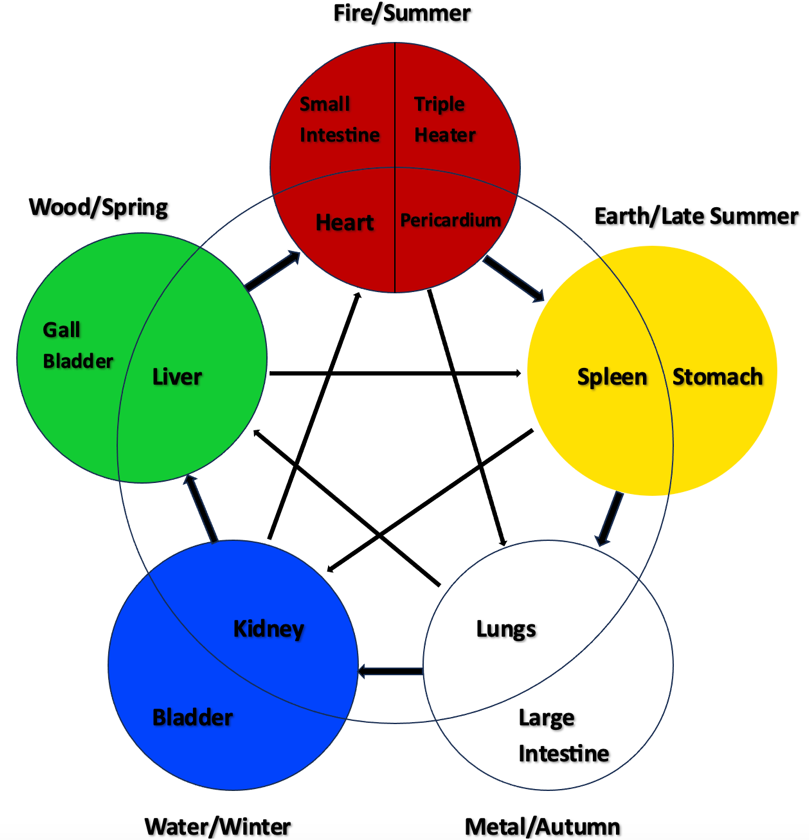
The Water element is associated with the winter, which is also the most yin time of the year. Yin characteristics include cold temperatures, short days, long nights, and general stillness and quiet. Like a tide that has receded back into the ocean, outward movement is minimal. Bodies of water freeze over, snow coats the landscape and nature’s pace slows considerably. While nature appears devoid of life, it has simply gone internal, preparing for the seasons ahead.
A hibernating bear epitomizes these seasonal energies – it’s time to rest, restore and rejuvenate. The bear prepares for winter by fattening up and then living off of its reserves until it’s once again time to emerge in the spring. Like the bear, we may find ourselves feeling especially tired, lethargic or hard to motivate. And that’s ok! While a standard response might be to drink more coffee and push through, nature’s response is to go gently, rest when possible and conserve energy – requirements if we are to feel vital, energized and ready to go in the spring. Again, we can learn from bears – they know how and when to conserve energy but they also know when to put forward their power and fearlessness to complete their goals.

Water also represents that which is mysterious, unknown and hidden. It is associated with the dream state and the imaginal realm – a place of infinite potential. A single seed has the potential to create 10,000 forests – that’s the power of water. If our reserves are scarce or we’ve not maintained them properly – by staying out late, excessively working or partying, not conserving our sexual energies – our response to the abyss may be fear, and we may try to distract ourselves even further. Although like the bear, if we’re maintaining adequate reserves, we’ll have more trust in stillness, and courage to explore our inner depths, potentially accessing deep wisdom. Like a bare tree, Water asks, “When all of life’s frills and adornments are dropped, what’s here? What’s left?”
There is wisdom in knowing when to hold back and when to move forward. Now is not the time to override ourselves and push through, because what we sacrifice is not only our health and wellbeing but our ability to be present with others. Thankfully nature offers itself as an example – for now, it’s time to rest.
Journaling
Journaling can be an excellent way to carve out a few minutes for deeper reflection. Our lives are often so busy that we can easily drown out our quieter inner voices that want to be expressed, and may even have solutions to difficulties we’re facing. Journaling of any kind can be helpful – a reflection on the day, stream of consciousness, or for more specific Water element explorations we might ask:
Where in my life am I making space for/prioritizing rest or restful activities? What are some ways I can replenish and rejuvenate myself?
What is my relationship to my own power? Am I giving it away? Are there boundaries that would be appropriate to set? How can I retain my power?
Do I know how to deeply listen both to my own needs and the needs of others? Can I listen just to listen, without needing to find an immediate solution?
Qi Gong
Qi gong is an excellent way to embrace the Water element – slow and gentle, yet deeply powerful. It was developed thousands of years ago as a branch of Chinese Medicine and it involves a series of slow, coordinated movements and mindful breathing. An ancient saying goes, “where there is free flow, there is no pain, where there is no free flow, there is pain.” By facilitating the free flow of qi, qi gong can help maintain health of body, mind and spirit. Mimi Kuo-Deemer is one of my favorite practitioners for Qi gong – her approach is clear, descriptive and informative. Here’s a link to her Water Element Qi Gong video. You’re welcome to try the whole sequence, or simply pick one or two moves that resonate with you and practice those.
Acupressure Points
What are they and how are they used? While needles have a more pronounced effect, these are acupuncture points that can be activated with finger pressure. Either press and hold the point with medium pressure, or, while engaging with pressure you can make small clockwise circles – either way, hold it for anywhere from 1-3 minutes on both the left and right sides of the body. This can be done as needed or a handful of times a day.
Kidney 3 (Tai Xi, Supreme Stream)
Location: On both legs, this point is found halfway between the highest point of your interior ankle bone and the Achilles tendon on the back of your leg.
Uses: It strengthens the lower back and can be used for anxiety stemming from high stress and overexertion. As an Earth point on a Water meridian, it can act like the banks of a stream preventing it from overflowing – thus supporting large emotions, especially fear and bringing security to our nervous system, calming the fight/flight/freeze response. In balance, the Kidneys give us strength, endurance and willpower. This point can help bring balance – not being too cautious or fearful and also not being reckless/careless with ourselves or our resources.
First let’s start with what’s helpful to limit. To maintain our energy levels, it’s helpful to avoid staying up late/waking too early, excessively working or partying and excessive sexual activity – essentially anything that drains our energy stores.
The best activities in winter are those that are flowing and mindful, allowing for appropriate movement and stillness. In addition to qi gong and journaling, this can be an excellent time to start or deepen a meditation practice. Even something as simple (though perhaps not as easy) is not filling time between activities with more activity can be helpful to bring more rest to your body and mind. Instead of picking up your phone while you wait for a zoom call to start, you might look out your window and admire a tree, or notice the feeling of your feet on the ground and your back against the chair, or the quality of your breathing. Returning to your body, you might notice where you’re holding tension or become aware of an emotion you’ve been holding but maybe haven’t fully expressed. Whatever you notice, see if you can bring curiosity and warmth to it, rather than judgment or shaming. Be with yourself as you would be with a good friend.
“Nothing in the world is as soft and yielding as water and yet for dissolving the hard and inflexible
nothing can surpass it.”
This is a quote from the seminal philosophical text the Tao Te Ching attributed to Lao Tzu. It’s a perfect reminder that while outward appearances of strength and hardness might appear indomitable, true power lies in our ability to remain soft, flowing and reflective. Massive canyons have been carved from the strength of water. It flows effortlessly around all obstacles, is formless - taking the exact shape of everything that contains it, and always finds the lowest point. It can be as forceful and destructive as a tsunami, as deep as an ocean, as endlessly flowing as a mountain stream, or as calm and tranquil as a still lake. When we can learn how to be with the element of water within us and embrace it’s seasonal gifts, we’ll be brimming with potential energy and fully prepared to bound forth and achieve our goals when spring arrives.
If you’re curious to explore how acupuncture can benefit you through seasonal or mental/emotional shifts, and would like to access deeper reserves of energy, please reach out. For more information about my practice, please visit here.
Warmly,
Corey